Debunking 5G: What the Badge Really Tells You
99% of plans have it: here's the number that matters instead
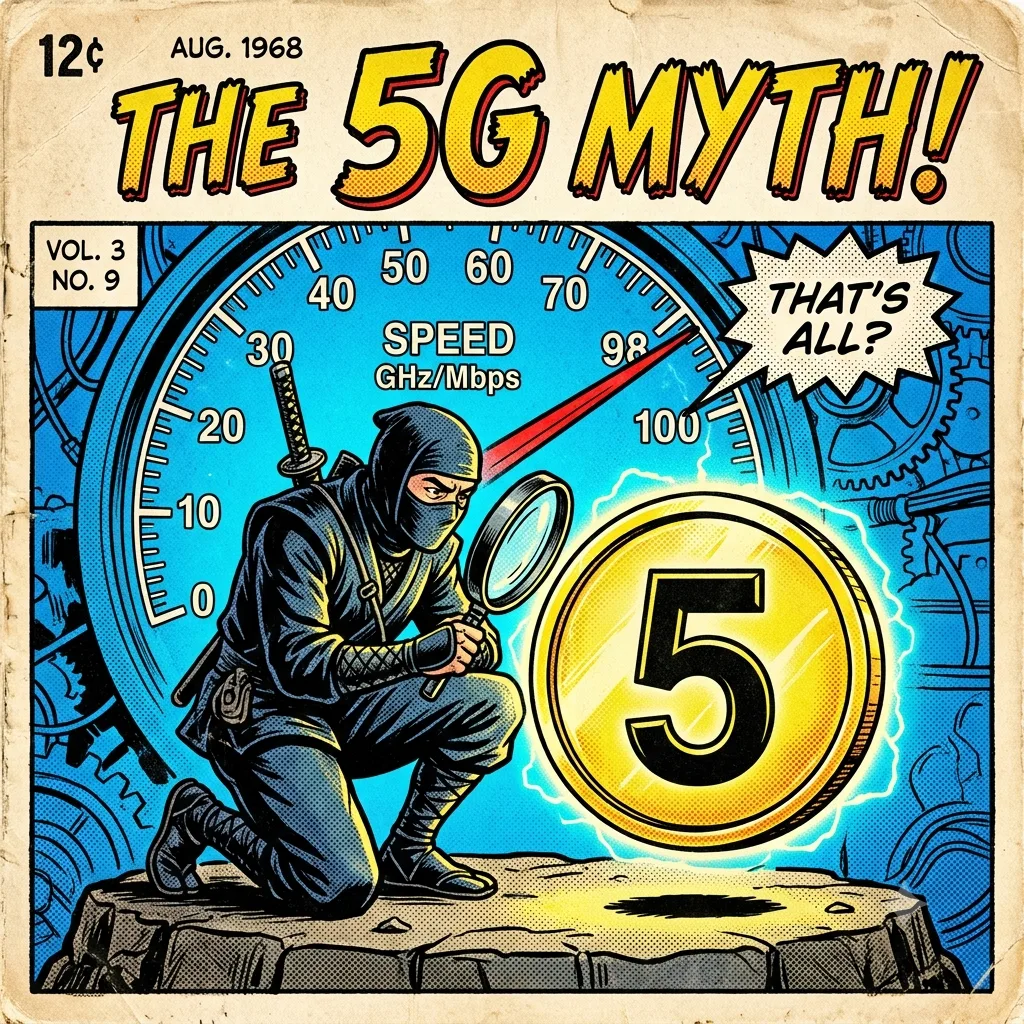
🥷 THE BADGE THAT STOPPED MEANING ANYTHING
In 2026, advertising a Swiss mobile plan with "5G!" is like advertising a car with "wheels included".
The count: all 176 plans have 5G. We even deleted the 5G filter from our own site: a filter that matches everything filters nothing.
So the badge is a decoy. The real intel hides one row deeper: the speed tier. Tonight's target. 🎯
“EVERYONE has it!”
🪜 THE HIDDEN SPEED LADDER
5G isn't one speed; it's a ladder, and providers price every rung:
- Quickline sells the same unlimited data at 300 Mbit/s (CHF 14 to 24), 1 Gbit/s (CHF 29) or 2 Gbit/s (CHF 69)
- Swisscom's blue ladder: blue Mobile M at 1 Gbit/s (CHF 81.80) → L at 2 Gbit/s (CHF 101.80) → XL at 2.3 Gbit/s (CHF 131.80)
- Yallo caps its Start family at 300 Mbit/s; the BLACK line runs 2 Gbit/s
- Wingo includes 300 Mbit/s on every plan by default and sells "Full Speed 5G" (up to 2 Gbit/s) as a CHF 5 add-on
The same "5G" on every poster. Up to 20× apart on the spec sheet. The MAX SPEED row on the card back is where plans actually differ. 🔬
🤷 AND WHEN NO SPEED IS PROMISED: "STANDARD"
Now for the market's quietest secret: for roughly a third of plans (August 2026), the provider publishes no 5G top speed at all.
We refuse to invent one. Those cards say "Standard", with a little ? that explains it. So what does standard 5G actually deliver?
- The ceilings: the operators report 5G at up to 1 Gbit/s for most of the population, and 2 Gbit/s where 5G+ is built out (figures published by the federal regulator ComCom)
- The everyday truth: independent measurements (nPerf) put average Swiss mobile speeds around 140 Mbit/s, among the fastest anywhere
- The context: a 4K stream sips about 25 Mbit/s
Translation: an unadvertised speed is not a slow lane. It's a provider that didn't print a number. 🧘
An "up to 2 Gbit/s" plan and a "Standard" plan usually feel identical on the train. The difference only shows up at the extremes: giant downloads, heavy hotspot days, and speed-test bragging rights.
📱 WHEN THE SPEED TIER ACTUALLY MATTERS
What everyday life needs:
- Video call: ~5 Mbit/s
- 4K stream: ~25 Mbit/s
- Everything above ~100 Mbit/s: comfort, not necessity
Pay for a higher tier if you:
- tether a laptop through your phone, often
- move giant files on mobile data
- simply want the ceiling (that's allowed too)
Don't pay for it because the poster said 5G. And remember: your location and your phone decide more than your plan does. The operators publish per-address coverage maps, the federal BAKOM atlas maps every 100-metre square, and networktest.ch (the official measurement tool) tells you what your spot really delivers. 🗺️
🎯 THE NINJA'S 5G CHECKLIST
Five moves, ten seconds:
1. Ignore the 5G badge: all 176 plans have it
2. Flip the card, read MAX SPEED: the number is the provider's stated maximum ("up to", not a promise)
3. See "Standard"? Tap the ? (no published cap, regular network 5G, typically 100 to 300 Mbit/s in daily use)
4. Coverage worries? Check your address on the official maps
5. Then buy on value: speed tiers are the tiebreaker, not the headline
The badge tells you almost nothing. Now you know where the truth hides. 🥷
“Speed ≠ badge!”
Read More Comics!
- 25 Brands, 3 Networks: Who Really Carries Your Calls?: The logo on your bill vs. the antennas on the mountain
- The Mystery of the Unlimited* Plan: What that little asterisk is really hiding